


Introduction: Professional Video Editing Course Skills Every Student Should Learn
Video is one of the strongest communication tools of the contemporary digital society. Social media and streaming services, online learning, and business promotion are only a few examples where people use videos to communicate and share information with their audience. Due to such a development trap, Professional courses help students develop essential video editing skills needed to create high-quality digital content. A video editing skills course is developed to enable the students to grasp the technical and creative bits of producing high-quality video content.
By 2026, not only film studios or television production houses will be able to video edit. The edited videos are vital to businesses, influencers, digital marketers, educators, and content creators to address their audiences. Consequently, professional video editing course skills provides individuals with numerous career opportunities in media, advertising, entertainment, and online communication.
An organized video editing course enables learners to transform raw footage into dynamic visual narratives. Students gradually build advanced skills learned in video editing course through hands-on practice and real projects. These competencies will help them to operate with ease with video editing programs, manipulate files in a media program, improve visual quality, and produce content that will attract the attention of the viewer.
This knowledge of what is taught in a professional video editing course skills can assist future editors to be ready for what an industry will expect. Such courses are devoted to the artistic and technical centre of editing to guarantee to the learners the full picture of the video production and post-processing.
Introduction to Basics Skills Learned in Video Editing Course
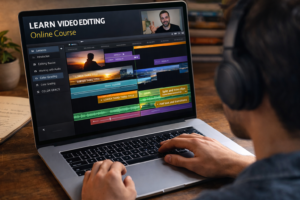
The basic foundation of video editing is one of the first skills that students learn during a professional video editing course skills. There are several items to take into account before the work with more advanced tools and effects, and the structure of a video, as well as its editing and resulting narrative, is a significant subject to consider. Students get to know how the separate clips may be structured so as to form a logical progression of scenes that would pass a clear message or story.
Continuity is a notion that is brought in in the early stages of training. The continuity is used to see that the scenes flow together and the viewer is not confused on the story to track. Editors are taught to ensure that there is a cohesive visual and narrative flow, which is achieved through the selective choice and arrangement of video clips.
The learners also have an insight into the popular editing styles that are applied in films, advertisements, documentaries and online videos. These methods assist in the formulation of the rhythm and velocity of the end video. By examining the professional editing process used to compile and polish the film, students begin to understand the importance of outlining how editing choices influence the tone and audience appeal.
Professional Video Editing Software
Studying professional video editing course skills will offer practical training in using industry-standard video editing software. This software enables the editors to edit clips, manipulate images and effects, and mix various media-related materials to come up with a final product of high quality. Editing software is a significant area where one should learn how to survive without having to work in video production.
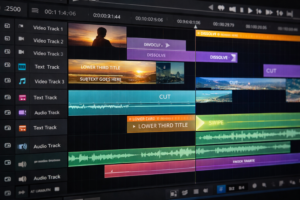
Students are taught how to bring in direct footage, how to organize project files and how to place the clips on the editing timeline. Editing the timeline is crucial, and you must learn to manage video, audio, and graphics layers. With constant practice, the students will learn how to handle several tracks and change them to attain the intended effects.
Besides clip editing, students will also be trained about the exportation of completed videos to various formats that allow them to be used on various platforms, including social media, sites and broadcasting media. Learning file formats and resolution settings would make sure that videos are not washed out in other devices and viewing conditions.
Storytelling Skills: Building with Editing
Video editing skills is no longer just about being technologically knowledgeable but also about storytelling. A professional editing course helps a student to acquire skills on how to employ editing techniques to develop narratives that are interesting to the audience. The editors have an important part to play in developing the way a story unfolds within a movie by determining what scenes should feature, the duration of a shot, and the transition of various points.
Students are taught how to turn raw footage into meaningful stories using practical exercises. They discuss the effects of pacing on viewers’ feelings and how some editorial decision-making can produce suspense, excitement, or clarity. Such skills in stories are particularly useful in areas like filmmaking and advertisement, as well as in digital content development.
The editors also learn how to retain the intended message of a video and eliminate unwanted footage. The ability to find the best moments in a recording is a key skill for creating concise, appealing content.
Learning About Video Transitions and Visual Flow
The reason why transitions are so vital in video editing skills is that they help to bridge various scenes within the video and ensure visual continuity. To ensure that the final video seems smooth and cohesive, a professional course teaches the students to use transitions in a certain way. Disorderly used, transitions may lead the viewers through the story without being distracted by them.
Students study various types of transitions and learn when each one is appropriate. Small effects like cuts and fades can be very effective compared to complicated effects in most instances, as they often maintain the viewer’s focus on the narrative rather than the transitions themselves. It is necessary that the editors should know the effects of transitions on the rhythm of a video and the way they helped to enliven its overall viewing.
Students learn how to have a sense of timing and visual balance by practicing different techniques in transitions. The skills learned in vedio editing course enable them to make attractive videos that are easy to follow.
Colour Grading and Colour Correction
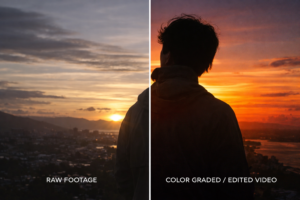
The role of colour in the perception of video content by the audience is significant. The professional video editing course skills presents the students to the colour correction and colour grading concepts. The processes enhance the visual aspect of the footage and the colours look natural and uniform.
Colour correction: It will mean correcting the brightness, contrast and colour balance between clips in the movie such that each clip is essentially the same in appearance. The step is critical when the recording of the footage was done under the influence of various lighting conditions or with the use of different cameras. The editors are taught how to rectify these differences so that they cause the same look throughout the video.
Colour grading is more concerned with creative improvement. It enables the editors to create a specific mood or style through adjusting the tone of colours and the visual ambiance. An example is that warm colours can be used to give a warm impression, and the use of cooler colours can be dramatic. The knowledge of these tricks can assist students in making their videos more emotional.
Sound Enhancing and Audio Editing
Sound is an essential part of a video production, and professional courses on editing teach students how to control the sound. Good audio quality will make people speak loudly with the viewer in a clear way, whether it is a conversation, narration or background music. Even visually impressive videos might not appeal to the audiences without the help of the proper sound editing.
Students are taught how to synchronize video clips and remove any undesired noise on videos. They also acquire the practice of changing the volume levels so that the speech and the music are in harmony throughout the video.
One more crucial skill is the ability to choose appropriate background music or sound effects that should be incorporated with the visuals. The editors are taught that sound plays a role in making the viewer feel, and it will also improve the process of telling the story. With the help of audio editing, students could design a more interactive image by synchronizing sound effects and music with the visuals to enhance the overall storytelling experience.
The Incorporation of Titles, Graphics, and Visuals
Contemporary video images and content tend to have titles, captions, and graphic-based images that communicate messages clearly. A video editing skills course is a professional course that teaches a student how these elements can be added to their projects effectively.
Documentaries, educative videos, and promotional materials are usually applied with titles and text overlays. Students get to know how to create readable and visually appropriate text elements in accordance with the overall style of the video. It is done well and at the right time so that the viewer will be able to fully comprehend what information is being presented.
Illustrations and graphics can be employed, too, to explain ideas or emphasize the main points. When learning how to incorporate these features, editors can create more informative and indulgent videos that engage the audience and enhance their understanding of the content being presented.
Understanding motion graphics and basic animation is essential.
Motion graphics have become a crucial element in modern video production. There are numerous professional classes that present the basics of animation and motion design to the students. The skills learned in vedio editing course also allow the editors to produce animated text, logos, and effects to improve the presentations in videos.
Students are taught through training how motion graphics can be employed to illustrate concepts, convey information or make a video captivating through graphics. Even basic animation can allow making any content dynamic and attractive to the audience.
Although specialized training might only be necessary in the case of complex animation, the knowledge of the fundamentals of motion graphics enables a video editor to be more creative and create more refined content.
Video Project Management and Organization
Professional video editors should have the skill of efficient project management. It is a common practice to have big volumes of footage, audio files, and graphic materials when editing any project. These elements may prove to be hard to control without proper organization, leading to inefficiencies and potential errors in the final product.
The professional video editing course skills teaches students how to organize their work methodically. They learn how to name files, organize folders, and have a proper workflow as they work through the editing process. The use of this organization enables the editors to work more effectively and it avoids the confusion in case of a complicated project, ultimately leading to a smoother editing process and higher quality final products.
Another important project-handling aspect is time management. The editors have to deal with deadlines frequently and at the same time deliver a quality video editing skills at the end of the day. Having experience on how to handle editing jobs has been known to equip students with real-world production.
Learning Video Formats and Output Settings
After the video project is made complete, it should be exported in the format that can be used on the desired platform. Various software, including social media platforms, websites, and TV shows, will demand a certain percentage of video settings, such as resolution and bitrate, to achieve the best quality of playback.
Professional video editing skills classes enable the students to learn how to manipulate resolution, frame rates and compression levels as they export the video. These technical details give one the ability to ensure that the final video is readable and professional across different devices.
The other thing that the editors are taught is how to optimize videos to stream online because file size and load speed could also influence viewers. With such export knowledge, students will be able to convey material that is compatible with various digital media, ensuring that their videos maintain quality and accessibility for audiences on different platforms.
Keeping up with New Technology of Video Editing
As new technologies emerge, the field of video editing skills continues to evolve. New courses expose students to the latest tools and techniques that will shape the future of video production. These can be automated editing tools, cloud-based collaboration tools, and artificial intelligence tools that help in the repetitive tasks, such as organizing footage, colour correction, and sound editing.
Students can be taught how to embrace new technologies so that they can be competitive in the industry. The productivity and creative output of professional editors would be enhanced in case they keep updated on new tools and workflows, as this knowledge allows them to leverage technology effectively and improve their editing processes.
Using the inputs of the traditional knowledge of editing and the new advancements, students have a wider outlook of how the industry functions and how it can possibly develop further within the next few years, allowing them to adapt to changes and innovate in their future careers.
Conclusion
A professional video editing skills degree course equips students with a diverse range of skills that combine creativity, technical proficiency, and storytelling abilities. These courses cover the basics of editing to the skill of colour repairing, audio restoration, and motion pictures, so there is the knowledge one gains to become skilled in the ability to work on an otherwise raw film to make a film that speaks volumes.
With the rise in popularity of video in the digital communication space, there is a high demand for skilled video editors in multiple sectors of marketing, entertainment, education, and online media. Those who take some time to learn professional styles of editing may gain useful skills that encourage cultural articulation and professionalization, such as understanding narrative structure, mastering editing software, and developing a unique editing style that resonates with diverse audiences.
With the development of these skills learned in vedio editing course and an interest in keeping up with the changing technologies, future video editors may be confident in their skills learned in vedio editing course and find new possibilities in the ever-growing world of digital production of media, such as creating innovative content for social media platforms, enhancing storytelling techniques, and adapting to new editing software and tools.
Disclaimer
The purpose of this article is only informational and educational. It talks about typical attributes instructed in professional video editing course skills programs and does not reflect curriculum or career objectives. Those who are interested in taking the video editing skills training should do their own research and take advice from educational institutions or trained professionals before making their choice in regard to courses, certification, or career growth in the sphere of video editing.
Frequently Asked Questions:
1. What skills can you learn in a professional video editing course skills?
A professional training program focuses on the most important skills learned in a video editing course, including storytelling, audio editing, and color grading. These skills learned in vedio editing course help transform raw footage into professional-quality videos.
2. Do I need prior experience to join a professional video editing course skills?
Most beginner-level video editing courses do not require prior experience. Training programs usually start with the fundamentals of editing, basic software tools, and simple editing techniques before moving toward advanced topics.
3. Which software is commonly taught in video editing skills courses?
Many professional courses introduce industry-standard editing software such as Adobe Premiere Pro, Final Cut Pro, DaVinci Resolve, and other editing platforms. Learning these tools helps students work on real-world video production projects.
4. Is storytelling an important part of video editing skills?
Yes, storytelling is a key aspect of video editing. Editors decide how scenes are arranged, how long each shot appears, and how transitions are used. These decisions help create an engaging narrative that captures the audience’s attention.
5. What is the difference between color correction and color grading?
Color correction focuses on fixing lighting and color balance issues to ensure consistency across video clips. Color grading, on the other hand, is a creative process used to enhance the mood and style of the video by adjusting tones and visual atmosphere.
6. Why is audio editing important in video production?
Audio editing ensures that dialogue, background music, and sound effects are clear and balanced. Proper audio enhances viewer engagement and improves the overall quality of the video content.
7. Can a video editing skills course help with social media content creation?
Yes, many video editing courses teach techniques suitable for platforms like YouTube, Instagram, and other digital channels. Students learn how to export videos in appropriate formats and resolutions for online publishing.
8. What are motion graphics in video editing skills course?
Motion graphics involve animated text, icons, logos, or visual elements used to enhance videos. These graphics can help explain concepts, highlight information, and make videos more visually engaging.
9. How important is project organization in video editing?
Project organization is essential when working with large volumes of video clips, audio files, and graphics. Learning how to structure folders, label files, and manage timelines helps editors work efficiently and avoid mistakes during editing.
10. What career opportunities are available after skills learned in video editing course?
Skills learned in vedio editing course can lead to opportunities in filmmaking, digital marketing, advertising, social media content creation, media production, and online education. Many editors also work as freelancers or collaborate with creative agencies.
11. How long does it take to learn professional video editing course skills?
The duration depends on the course structure and learning pace. Some training programs last a few weeks, while others may take several months to cover advanced editing techniques and practical projects.
12. Is video editing skills course a good career in the digital era?
Yes, video editing skills is considered a valuable skill in the digital era because video content is widely used in marketing, entertainment, education, and social media. Skilled editors are increasingly in demand across many industries.