


Introduction: The Role of Artificial Intelligence in Digital Marketing Education
Over the past decade, AI in Digital Marketing Training has undergone radical changes. What used to be mainly concerned with search engine optimization, management of social media, and online advertising has acquired a strong new component of artificial intelligence. In 2026, AI in Digital Marketing Training technologies have fully penetrated the learning, practicing, and execution of the digital strategies by the marketing professionals.
AI in Digital Marketing Training programs no longer dwell on some theoretical ideas or manuals of running the campaign. The traditional digital marketing programs have been enhanced with smarter AI Tools in Digital Marketing Courses to help in research, automation, personalization, and performance analysis. These technologies are transforming the mode of student and professional learning marketing skills.
The implementation of the solution of Artificial Intelligence in Digital Marketing Education by industries leads to the need to adjust digital marketing education so that students could be ready to work in a fast-evolving professional landscape. Learning to act in the context of artificial intelligence affecting training processes, educational structure and skill acquisition is a must-have aspect for every individual aspiring to work in digital marketing.

How AI Tools in Digital Marketing Courses Improve Learning
Artificial intelligence has ceased to be the realm of the future, and it is already a part of business reality. With AI systems, high levels of data can be analyzed and trends identified, customer behaviour predicted, and previously repetitive procedures can be automated in marketing. The abilities enable companies to be quicker and more correct in their decisions.
Since organizations are gradually shifting towards the usage of AI-based platforms, the needs of digital marketing education should incorporate the shifts within the industry. In Many institutes are integrating AI in digital marketing training to prepare students for modern marketing careers. Learners are also being taught to work with systems that are intelligent as opposed to relying on manual methods of marketing only.
The inclusion of AI in digital marketing education implies that students will be aware of the possibilities of automation, as well as its disadvantages. Courses are now focused on critical thinking and strategic decision-making as well as responsible AI technology use.
Digitization of Smith Digital Marketing Program
Among the most evident implications of artificial intelligence that are expected in 2026, the change in the structure of digital marketing courses can be identified. The classic modules of traditional modules that used to limit themselves to SEO, email marketing, and content creation are being developed to accommodate AI-related subjects.
The new courses are teaching the students on how to use AI Tools in Digital Marketing Courses to help in researching keywords, optimizing content, segmenting customers, and making predictions. The students do not just acquire the concepts of marketing but also experience the use of smart platforms that are generally applied in real-life campaign activities.
The curriculum in Artificial Intelligence in Digital Marketing Education institutions is also changing regularly due to the fact that AI technology is changing at a rapid pace. Such continuous revision keeps the students abreast of what is going on in the industry and the up-to-date AI Tools in Digital Marketing Courses.
The learning platforms are AI-powered.
The other significant shift in AI in Digital Marketing Training is the use of AI in learning systems. AI tools in digital marketing courses help students automate research and campaign analysis.
AI systems keep the level of difficulty and the content that is presented according to the performance of a particular student instead of employing a standard learning route for all learners. When a learner has an issue with a certain concept like pay-per-click advertising or analytics decoding, the system would suggest more practice or different explanations.
This flexible learning method enhances knowledge retention and makes students learn complicated digital marketing tactics in an effective way. AI-based learning applications should also enable teachers to track the behaviour of students better and where further instructions might be needed.
Automation of Practical AI in Digital Marketing Training
Practical AI in Digital Marketing Training is a key component of digital marketing learning, and artificial intelligence has altered the way students acquire practical learning experience by a great deal. In the previous training methods, the learners did a lot of manual work, such as analysis of keywords, research on competitors and reporting on the performance.
Most of these processes are now automated by AI Tools in Digital Marketing Courses. In the course of the AI in Digital Marketing Training, students are taught how to interpret the results of artificial intelligence and use them in real-life marketing strategies. Learners, instead of wasting a lot of time trying to work on similar processes, are able to work on strategy development and campaign optimization.
This change is an expression of the real industry trends, with marketers having to turn to AI systems to process the data fast and human specialists influencing the overall direction.
Predictive Marketing Skills / Data Analysis

Modern-day marketing relies heavily on data and artificial intelligence has enhanced the manner in which data are analyzed significantly. In 2026, the focus of digital marketing training would go towards the skills of data interpretation since AI platforms can provide detailed performance data within a few seconds.
Students are trained to comprehend the predictive analytics process and how AI models predict the behaviour of the consumer. Such insights assist marketers to foresee the trends, modify campaigns, and enhance targeting of audiences.
Knowing how to digest data generated by AI is now viewed as an important competence in learning digital marketing. Courses deal with the knowledge of metrics, the AI recommendations, and making strategic decisions grounded in credible information.
Creation of Content and Artificial Intelligence
Digital marketing still focuses on content marketing. Nevertheless, the field of artificial intelligence has brought new methods to content production, editing and optimization.
Digital marketing courses today incorporate the lessons on how students should cooperate with the AI writing tools, content design assistants, and content optimization platforms. The tools are useful in producing ideas, studying the trends of the audience interactions, and providing recommendations on how the site should be further optimized to ensure increased visibility on search engines.
Training programs stress the need to have originality, creativity, and human judgment even though AI continues to play an increasingly important role in content creation. Students are taught that AI must facilitate the creative process as opposed to usurping the thinking and telling of stories by humans.
Individualized marketing plans
The idea of personalization has become one of the most significant features of contemporary digital marketing. Consumers will require their brands to provide informative content, suggestions, and ads depending on their preferences and tendencies.
AI helps a marketer to examine the data about users and provide the most specific advertising campaigns. Consequently, the courses on digital marketing consist of the use of AI algorithms to recognize the preferences of customers and divide them into categories.
Students gain the knowledge of personalization technologies functioning and understand how to create marketing campaigns that should not violate the privacy rules yet enhance customer interactions. The learning of the privacy versus exploitation with regard to customizing and using data in marketing is now a significant aspect of Artificial Intelligence in Digital Marketing Education.
Artificial Intelligence in Advertising and Campaign Optimization
The online advertising websites are becoming more dependent on artificial intelligence to control a bid strategy, audience targeting, and placing advertisements. Students are now learning how to make use of these AI-driven advertising systems, which have been taught under the digital marketing courses.
AI in Digital Marketing Training will entail knowledge of automated bidding systems, automated performance forecasting systems, and machine learning-driven campaign optimization capabilities. Students also get to know how to analyze the metrics of the advertising performance and to make changes accordingly.
Having gotten acquainted with AI-based advertising platforms, the learners will be more equipped to work in the real marketing environment, where automation is a norm in dealing with campaigns.
Moral Implications and Two-Way AI
Although artificial intelligence has numerous benefits, it also provokes some significant ethical concerns. In 2026, the topic of responsible use of AI, transparency and privacy of data is discussed during the digital marketing training.
The students are urged to learn how algorithms work and how bias or false information would affect marketing choices. AI in Digital Marketing Training procedures teach about the need to safeguard user data and adhere to the rules and regulations of digital privacy.
Ethical AI practices create a responsibility dimension on how The future of AI in digital marketing training will continue to transform how marketers learn and apply new strategies.
The Digital Marketing Professionals Are Changing
The emergence of artificial intelligence does not help to substitute human marketers. Rather, it transforms the skills that are necessary to become successful in the industry. At this point, digital marketing specialists have to integrate both technological expertise and their creativity, strategic thinking, and communication capabilities.
The training programs aim at getting these hybrid capabilities. Students get to know how to use AI Tools in Digital Marketing Courses and retain the power to control marketing strategies and brand messaging.
The change develops learners and readies them to work in a professional world, where man and intelligent systems work together to come up with improved marketing results.
Career Opportunities in an AI-Based Marketing Environment
New career opportunities are appearing as more job opportunities emerge as artificial intelligence gains prevalence in digital marketing. Business companies need specialists that possess a sense of marketing as well as an AI-driven application.
The AI in Digital Marketing Training programs will be noted to train the student in conducting digital marketing skills in marketing automation, examining data, marketing performance, and the content strategy, facilitated by AI, in the year 2026. Such skills will render graduates more flexible in the fast-changing job market.
The employer is becoming more appreciative towards candidates who are able to read AI indications, handle the use of automated systems, and devise innovative marketing campaigns that can simply be identified in a competitive digital marketplace.
Conclusion
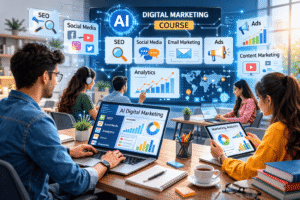
The training of digital marketing is changing dramatically due to artificial intelligence. Technology is redefining what it means to be a marketer going forward with the introduction of personalized learning platforms, AI-enabled content creation, and predictive analytics.
In 2026, the learning of digital marketing is not centred on the conventional principles of marketing but on the ability to learn about the ways smarter systems can improve decisions and campaign management. Students are being trained to develop analytical thinking and develop innovative problem-solving skills as they work with high-level technological devices.
Certainly, with a further development of AI in digital marketing training programs will be modified in different ways, and new technologies, as well as instructional approaches, will emerge. Those professionals who conceptualize how to incorporate AI into marketing in a responsible manner would find it easier to adjust to the future of digital marketing.
Disclaimer
The article is purely informational and educative. The content dwells upon the overall trends and trends in the area of artificial intelligence and digital marketing training. It is not professional, financial or career guidance. The readers are advised also to do the independent investigation and refer to the qualified specialists or higher Artificial Intelligence in Digital Marketing Education institutions before registering for any AI in Digital Marketing Training program or career decision involving digital marketing or artificial intelligence.
Frequently Asked Questions:
1. What role does artificial intelligence play in AI in Digital Marketing Training in 2026?
Artificial intelligence plays a major role in modern digital marketing training by helping students learn automation, data analysis, predictive marketing, and campaign optimization. AI Tools in Digital Marketing Courses allow learners to analyze marketing data quickly and make smarter strategic decisions.
2. How are digital marketing courses changing due to AI?
Digital marketing courses are evolving to include AI-based modules such as automated content creation, keyword research using AI Tools in Digital Marketing Courses, predictive analytics, and marketing automation platforms. AI in Digital Marketing Training now focuses on both traditional marketing skills and AI technology integration.
3. Why is AI important for future digital marketers?
AI helps marketers understand large amounts of customer data, identify trends, personalize campaigns, and improve advertising performance. Learning how to use AI Tools in Digital Marketing Courses gives marketers a competitive advantage in the modern digital marketing industry.
4. Can AI replace human digital marketers?
No, AI cannot completely replace human marketers. Instead, it assists them by automating repetitive tasks and providing data insights. Human creativity, strategy, storytelling, and decision-making remain essential in digital marketing.
5. How does AI improve practical training in digital marketing courses?
AI improves practical training by automating tasks like keyword research, competitor analysis, and campaign reporting. Students learn how to interpret AI-generated insights and use them to optimize real marketing campaigns.
6. What AI tools are commonly used in AI in Digital Marketing Training?
Common AI Tools in Digital Marketing Courses include AI content generators, marketing automation platforms, predictive analytics tools, AI-powered SEO tools, and smart advertising platforms that optimize ad performance.
7. How does AI in Digital Marketing Training help in personalized marketing strategies?
AI analyzes user behavior, preferences, and browsing patterns to help marketers create personalized advertisements, emails, and content. This improves customer engagement and increases the effectiveness of marketing campaigns.
8. What skills should digital marketing students learn in the AI era?
Students should learn data analysis, marketing automation, AI-based content optimization, campaign analytics, audience segmentation, and strategic thinking. Combining technical knowledge with creativity is essential for success.
9. Are AI-powered learning platforms used in Artificial Intelligence in Digital Marketing Education?
Yes, many AI in Digital Marketing Training platforms now use AI to personalize the learning experience. These systems track student performance, adjust course difficulty, and recommend additional resources based on individual progress.
10. What career opportunities are available in AI-driven digital marketing?
Career opportunities include roles such as AI marketing specialist, digital marketing strategist, marketing automation expert, SEO analyst, data-driven marketing consultant, and performance marketing manager.