


The Digital Education Emergence of Artificial Intelligence.
Artificial intelligence is no longer a high-technology dream but a reality influencing real-life professional activities. This change is particularly evident in the area of digital marketing education. Captured courses that formerly offered nothing more specific than platforms, content, and analytics have begun incorporating AI-powered tools and ideas to represent the realm of actual industry functioning. To learners, this transition is a chance to not only acquire the basics of digital marketing but also the ways smart systems can make the whole process efficient and accurate, as well as better in decision-making.
AI in digital marketing course is not regarding the substitution of human innovation or plans. Rather, it is concentrated on enhancing human capacity through robotizing repetitive processes, refining more insights in data and making interactions with more personal audiences possible. This power facilitates the fact that learners are not taken into modern marketing environments but instead into areas that are outdated.
Getting the idea of AI in digital marketing course.
Digital marketing with AI tools involves systems that are able to work with large volumes of data, spot trends, and offer predictions or recommendations with a limited number of human interventions. The skills enable the marketers to know the behavior of the people at a level and depth that was not feasible before.
The use of AI in planning campaigns, content optimization, targeting customers and analyzing performance has become part of the learning experience of AI in digital marketing course. Educating students on these concepts at a young age provides them with a clear insight into how intelligent tools can drive strategic decision-making and at the same time leave all creativity and ethics at the mercy of human judgment.
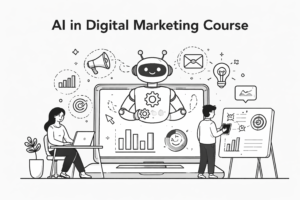
The reasons behind how AI has become a communication marketing focus.
The fast implementation of AI in the industries has transformed the expectation of the employer. Businesses are also eager to find employees who are able to operate on AI-based systems without being confined to manual operations only. Consequently, digital marketing education has become digitally savvy by integrating AI literacy as one of its essential elements.
Programs with AI integrate students to work in actual surroundings where automation, predictive analysis and personalization are the norm. Such a meeting of the neighborhood demand in education and industry renders AI in digital marketing course very pertinent and future-oriented.
Striking the Balance between the Industry Practice and Theory.
A discrepancy in academic learning and industry needs has been one of the persistent issues of professional education. The integration of AI can address such a gap by showing learners the tools and workflows applied in modern organizations. Instead of studying concepts in a vacuum, students get a visualization of how AI-motivated insights can lead to campaign results.
This real-world experience creates confidence and competence. Students are also aware of the existence of the strategies and how AI can help to implement them in the conditions of a dynamic market.
The concept of personalization as a fundamental learning concept.
AI in digital marketing course has its success being characterized by personalization. AI allows marketers to customize content and recommendations as well as communication according to individual user behavior. Personalization has become the technical and strategic concept that is brought to the fore in digital marketing courses.
Students are taught about AI examining the data provided by users to prenatal desires and provide relevant experiences. This can be understood to make learners realize that there is a balance between automation and responsible data usage, which is central in marketing practices that are sustainable.

Artificial Intelligence and Data-Driven Decision-Making.
Digital marketing with ai tools has always been strategic in its use of data, yet the use of AI has revolutionized data application. Personally, AI systems analyze large volumes of data in real time as opposed to manual analysis and supply hotspots and trends that could be overlooked by a human person.
The AI in digital marketing course educate learners to make sense of the insights that are generated by AI and use them in a strategic manner. This ability is critical since any outputs done by AI can only be of value when comprehended and applied well. Students acquire critical thinking and technical acquaintance.
Geo-Creation and Optimization Aided by AI content.
The content is the key element in digital marketing and AI has brought new opportunities to facilitate the content creation and optimization. The courses discuss the way in which AI tools can help with research on topics, making predictions, and refining the content, but they never override human creativity.
Through these approaches to learning, the students learn how to employ AI as a productivity tool. They are also taught how to be original and ethical so that the content will be original and focused on the audience.
Autonomous and efficient campaign management.
Digital campaign management is full of repetitive work that is time-consuming and resource-consuming. The concept of AI-led automation has altered this fact by automating the bidding, performance monitoring, and scheduling preparation processes.
AI in digital marketing course discuss the role of automation to enhance efficiency as well as that of strategic control. Students will witness how AI can cope with the complexity of work, and marketers will be able to be engaged in planning, creativity, and the future perspective.
The AI in Marketing: Ethical Implications.
Ethical considerations are now more important as AI acquires power. The review of data, transparency, and consumer trust is a vital topic of contemporary AI in digital marketing course. These issues are now being incorporated in courses so that learners may be aware of their professional duties.
The lessons on ethics and digital marketing with AI tools will enable students to mature in their judgment. They understand that marketing should be efficient in terms of the ability to use technology without violating traditional standards of privacy and respect for the society.
This paper offers an overview of how to prepare learners to work in AI-enhanced careers.
The profession of digital marketing is changing with the use of AI. Frontline jobs are becoming more and more demanding in terms of the knowledge of intelligent software, whereas high-level jobs are becoming more demanding in terms of strategic management of AI-based systems. It is the entire spectrum of careers undertaken by courses that use AI to prepare the learners.
Student learners can be flexible by knowing about AI at the early stages. They feel at ease with tools that are emerging and changes in strategies with technology improving, which will be vital for long-term career resilience.
Learning on the Job in an Ever-Changing Environment.
Digital marketing with AI tools is dynamically changing with the advancement in technology and the release of new functionalities in platforms. Courses focus on lifelong learning and not on knowledge. Students are advised to keep abreast and test stuff in a responsible manner.
This mentality equips students to survive in a profession that is dynamic. They are no longer afraid of automation, but instead, they learn to coexist with it and see AI not as a danger but as an ally.
Predictive Insights, aiding strategy building with insights, is a service offered by the company.
Predictive facets of AI enable marketers to forecast the trends, consumer demands, and the outcomes of the campaign. Online marketing classes describe how these findings can be used to develop proactive strategies and not reactive ones.
Learners get to know how to use predictive data with intuitions. This integration enhances work on strategic planning, as well as the quality of decisions made, which supports the notion that AI complements, not eliminates, professional competence.
The availability of AI knowledge to new learners.
The recently developed digital marketing classes can enable even a novice to understand the concept of AI. Tools and ideas are not presented to the learners at a steep pace or require progressive technical knowledge. This inclusivity makes it possible to ensure that students with different educational backgrounds are able to gain.
AI in digital marketing in courses help eliminate fear and misunderstandings by demystifying AI. The students acquire self-confidence when working with intelligent tools in their daily working process.
The long-term effect on the marketing profession is huge because it became job-focused, with experts in this field striving to create a pathway that enables the comprehension of the evolution of the profession over time.
The adoption of AI in the field of digital marketing higher education is an indication of a paradigm shift in the field over time. The future marketer will have to be knowledgeable about human behavior and intelligent systems. Majors that are based on this fact equip students with leadership and innovativeness.
This development transforms AI in digital marketing course to be an element of strategy rather than a practice. Individuals who receive education in AI-based strategies have a better impact on organizational development and surpass sustainability.
Final Thought
The concept of AI in digital marketing course is an important move towards making education relevant to the environment of the contemporary industry. Incoming knowledge about the most recent trends and tools can help students not only acquire technical skills but also strategic understanding, moral awareness, and flexibility. With the growing level of smartness in digital environments, human creativity and AI-based assistance will become the success mark. When it comes to deciding to study digital marketing and adopt an AI-driven model, it is also not a question of how to keep up but rather of how to prepare to live in a future that is informed by collaboration between humans and technology and that defines meaningful digital experiences.
Frequently Asked Questions (FAQ) on AI in digital marketing courses
What is the role of AI in modern digital marketing courses?
AI plays a supportive role in AI in digital marketing courses by helping learners understand how intelligent systems assist in data analysis, personalization, automation, and strategic decision-making. It enhances learning without replacing human creativity or judgment.
Why is AI being included in AI in digital marketing course now?
AI has become central to how businesses operate online. Employers expect professionals to understand AI-powered tools, so AI in digital marketing course has evolved to stay aligned with real-world industry practices and future workforce demands.
Do AI-based digital marketing courses require a technical or programming background?
No, most AI in digital marketing courses are designed for beginners and do not require prior technical or programming knowledge. Concepts are taught in an accessible manner to help learners understand practical applications rather than complex coding.
How does AI help in understanding customer behavior?
AI systems analyze large volumes of user data to identify patterns, preferences, and trends. This allows marketers to understand audience behavior more deeply and create more relevant, personalized marketing strategies.
Will AI replace human creativity in digital marketing?
AI does not replace creativity. Instead, it supports marketers by handling repetitive tasks and data processing, allowing professionals to focus more on strategy, storytelling, creativity, and ethical decision-making.
How does AI improve personalization in digital marketing?
AI enables personalized content, recommendations, and communication by analyzing individual user behavior. Digital marketing courses teach students how to use these insights responsibly to improve user experience and engagement.
What ethical considerations are taught regarding AI in digital marketing courses?
Courses address issues such as data privacy, transparency, consumer trust, and responsible use of automation. Students learn that ethical judgment is essential for sustainable and trustworthy digital marketing practices.
How does AI support data-driven decision-making in marketing?
AI processes data in real time and highlights trends or performance insights that may be overlooked manually. Learners are trained to interpret these insights and apply them strategically rather than relying blindly on automation.
Does learning AI in digital marketing course improve career opportunities?
Yes, understanding digital marketing with AI tools and trends prepares learners for evolving job roles in digital marketing. It increases adaptability, enhances professional relevance, and supports long-term career resilience in a changing industry.
Is AI knowledge useful for beginners in digital marketing?
Absolutely. Modern courses introduce AI concepts gradually, helping beginners gain confidence and familiarity. This early exposure makes learners more comfortable working in AI-enhanced marketing environments.
How does AI help in content creation and optimization?
AI assists with research, trend analysis, and content optimization suggestions. Courses emphasize using AI as a productivity aid while maintaining originality, creativity, and ethical content standards.
Why is AI considered essential for the future of digital marketing?
As digital platforms continue to evolve, AI-driven insights, automation, and predictive capabilities are becoming standard. Learning AI prepares marketers to remain relevant and effective in future digital ecosystems.

